
Quick Answer
Food distribution warehouses keep products safe and market-ready by combining food-grade storage, temperature control, and disciplined inventory management with documented compliance at every step. In Vancouver, that means CFIA-aligned processes, lot traceability, and retailer-ready handling from receiving through final delivery.
Food doesn’t wait. Every hour a shipment sits in the wrong environment, or every pallet that’s mislabeled at receiving, chips away at shelf life and profit. That’s the quiet pressure behind every food supply chain, and it’s exactly why food distribution warehouses exist in the first place.
For businesses shipping through British Columbia’s Lower Mainland, the stakes are even higher. Vancouver is a major port and border gateway, which means food products are constantly moving between ships, trucks, and store shelves. A single break in temperature control or paperwork can trigger a rejected load, a costly delay, or worse, a recall.
This article breaks down how modern food-grade warehousing services actually protect product quality and keep businesses compliant, along with practical tips for choosing the right partner in Vancouver.
What Are Food Distribution Warehouses?
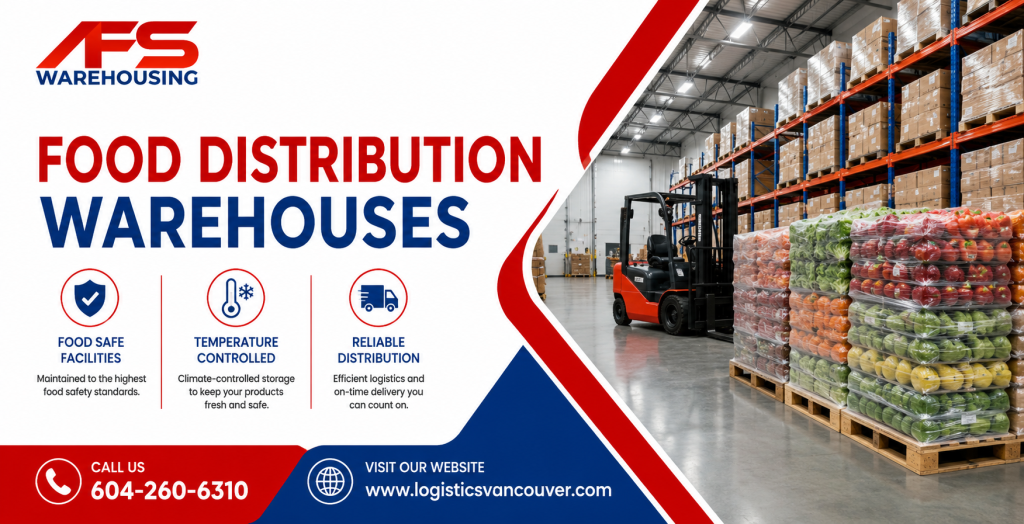
A food distribution warehouse is a facility built specifically to receive, store, and move food and beverage products while maintaining strict hygiene, temperature, and traceability standards. Unlike a general storage facility, it’s designed around the reality that food is perishable, regulated, and closely tracked from the moment it arrives until it reaches a store shelf or a customer’s door.
These facilities typically handle several jobs at once: short and long-term storage, order picking, repacking, cross-docking, and documentation for regulatory bodies and retail partners. Done well, this keeps products fresher for longer and keeps a business’s supply chain audit-ready at any time.
Why Food-Grade Warehousing Matters for Vancouver Businesses
Vancouver’s food and beverage sector serves both domestic retailers and cross-border customers, which raises the bar for compliance. A facility that isn’t set up as a proper food grade warehouse in Vancouver puts a business at risk of contamination issues, failed audits, and lost retail contracts.
Working with a warehouse built for food from day one, rather than a converted general-purpose facility, gives businesses a real advantage:
- Lower risk of spoilage from inconsistent temperatures
- Fewer compliance issues during CFIA or retailer audits
- Faster, more accurate order fulfillment
- Better visibility into stock levels and expiry dates
- Reduced liability if a recall situation ever arises
Core Functions of Food Distribution Warehouses
1. Temperature-Controlled Storage
Food products need the right environment, whether that’s ambient, chilled, or frozen. Reliable temperature-sensitive storage for beverages and perishable goods is one of the clearest signs a facility understands food logistics rather than treating it like any other commodity. Continuous monitoring, backup systems, and clearly zoned storage areas all matter here.
2. Inventory Management Food Systems
Strong inventory management food processes are what separate a well-run warehouse from a risky one. This means real-time stock visibility, first-expired-first-out (FEFO) rotation, and lot-level tracking so that every unit can be traced back to its receiving date and supplier.
A warehouse management system (WMS) built for food handles this automatically, flagging aging stock before it becomes a write-off and giving businesses accurate data for demand planning.
3. Cross-Docking and Fast Turnaround
Some food products, especially fresh or short-shelf-life goods, shouldn’t sit in storage any longer than necessary. Cross-docking services move inbound shipments straight to outbound trucks with minimal handling, which shortens the time a product spends off the shelf and reduces the risk of spoilage.
4. Repacking and Retail Compliance
Retailers often have very specific labeling, packaging, and pallet configuration requirements. A capable partner offers food and beverage repacking services along with major retailer compliance programs that reformat products to meet each chain’s exact specifications, which helps avoid rejected deliveries and chargebacks.
Compliance Standards Food Distribution Warehouses Must Meet
Compliance isn’t a single checkbox. It’s a set of overlapping standards that food distribution warehouses need to maintain continuously, not just before an inspection.
| Standard / Requirement | What It Covers | Why It Matters |
|---|---|---|
| CFIA licensing | Food safety oversight for facilities that store or handle food products in Canada | Required for legal operation and full traceability |
| HACCP-based procedures | Hazard Analysis & Critical Control Points across receiving, storage, and picking | Reduces contamination and spoilage risk |
| Temperature monitoring logs | Continuous tracking of chilled, frozen, and ambient zones | Protects product integrity and supports audits |
| Lot and batch traceability | Tracking each product batch from inbound receiving to outbound shipment | Enables fast, targeted recalls when needed |
| Retailer compliance rules | Labeling, packaging, EDI data, and delivery windows for major grocery chains | Avoids chargebacks and rejected shipments |
| Pest control and sanitation | Scheduled inspections and cleaning protocols | Maintains a true food-grade environment |
How Food Product Logistics Vancouver Businesses Depend On
Warehousing is only one link in the chain. Food product logistics in Vancouver also covers transportation, drayage from the port, cross-border movement, and last-mile delivery. When storage and transportation are coordinated by the same partner, businesses see fewer handoffs, less paperwork duplication, and tighter control over product condition from the moment it lands to the moment it’s delivered.
This is particularly important for companies importing through the Port of Vancouver, where customs clearance, drayage timing, and warehouse receiving all need to line up closely to avoid demurrage fees and unnecessary storage costs.
Expert Tips for Choosing a Food Grade Warehouse in Vancouver
Not every facility that says it can store food actually operates to food-grade standards. Here’s what to check before signing a contract:
- Verify CFIA registration and any relevant food safety certifications before touring the facility.
- Ask about temperature zone flexibility, including ambient, chilled, and frozen capacity.
- Review the provider’s inventory management food systems and how stock rotation is tracked.
- Confirm lot and batch traceability procedures in case a recall is ever necessary.
- Check proximity to the Port of Vancouver and major highway routes to reduce transit time.
- Ask about cross-docking and repacking capabilities for faster order turnaround.
- Request references from other food and beverage clients they currently serve.
Common Challenges in Food Logistics and How Warehouses Solve Them
Seasonal Demand Spikes
Holiday periods and promotional pushes can overwhelm storage and picking capacity. Warehouses built for food logistics plan for this with flexible space and scalable labor, rather than scrambling when volume jumps.
Short Shelf-Life Products
Fresh and perishable goods leave little room for error. FEFO-based inventory management food practices and fast cross-docking keep products moving before quality declines.
Retailer-Specific Requirements
Each grocery chain has its own labeling and packaging rules. Dedicated repacking lines and compliance checks catch these details before shipments leave the facility, not after they’re rejected.
The Role of Technology in Modern Food Logistics
Barcode scanning, automated temperature logging, and cloud-based warehouse management systems have made it far easier to prove compliance and catch problems early. For food logistics specifically, this technology also feeds directly into inventory management food workflows, giving businesses a live view of what’s in stock, what’s aging, and what needs to move next.
Businesses that want a deeper look at how these systems work together can browse the Logistics Vancouver blog for more warehousing and supply chain insights.
Conclusion
Food distribution warehouses do more than hold inventory. They protect product quality, keep businesses compliant with food safety regulations, and help goods move efficiently from port to shelf. For companies operating in and around Vancouver, choosing a partner with real food-grade infrastructure, strong inventory management food practices, and proven compliance processes makes a measurable difference in cost, spoilage, and reliability.
If your business needs dependable food product logistics in Vancouver, it’s worth talking to a team that handles this daily. Contact Logistics Vancouver to request a free quote and see how a properly run food-grade facility can support your supply chain.
Frequently Asked Questions
Everything you need to know about food distribution warehouses & food-grade logistics.