


Quick Answer
Good inventory management food systems reduce waste and costs by tracking stock in real time, rotating products on a first-in, first-out basis, and matching orders to genuine demand instead of guesswork. Paired with reliable storage logistics Vancouver businesses trust and the right freight strategy, this stops overordering, spoilage and rushed emergency shipments typically cutting waste-related losses by 15–30% within a year.
Walk into any busy warehouse whether it’s stacked with pallets of tinned goods or rows of flat-packed furniture and you’ll notice the same thing: the businesses that thrive are the ones that know exactly what they have, where it is, and how long it’s got left to sell. That’s the whole idea behind good inventory management. Food businesses feel the pressure of this most acutely, because a missed rotation date doesn’t just mean a markdown, it means a bin bag. But the lessons apply just as directly to furniture retailers juggling seasonal stock, showroom returns and warehouse space that costs money whether it’s full or half-empty.
In this guide, we’ll unpack how modern inventory management food systems actually reduce waste and cut costs, where storage and freight decisions fit into that picture, and what any product-based business furniture included can borrow from the discipline that food logistics demands.
What Is Inventory Management in the Food Supply Chain?
At its simplest, inventory management is the process of tracking stock as it moves from supplier to shelf quantities, locations, expiry dates and turnover speed all included. For food businesses, this tracking has to be near-constant, because shelf life is a ticking clock that furniture stock simply doesn’t have.
A well-built inventory management food system typically combines barcode or RFID scanning, warehouse management software, and clear rotation rules, so that staff always know which pallet needs to move first and which one can wait.
FIFO and FEFO: The Backbone of Waste Reduction
- FIFO (First In, First Out): the oldest stock received is sold or shipped first.
- FEFO (First Expired, First Out): stock is prioritised by expiry date rather than arrival date — critical for perishables.
- Both methods rely on accurate, real-time data; without it, staff are rotating stock by guesswork.
Why Waste Creeps In Before Anyone Notices
Waste rarely happens because of one big mistake. It builds up quietly, through small inefficiencies that compound over weeks:
- Overordering because nobody has a clear, real-time view of current stock.
- Poor rotation, leaving older stock buried behind newer deliveries.
- Temperature swings in storage that shorten shelf life without anyone realising.
- Manual spreadsheets that are updated a day (or a week) too late.
- Freight scheduled without matching it to how quickly stock actually needs to move.
Any one of these on its own is manageable. Together, they quietly erode margins and this is exactly where a proper inventory management food system earns its keep.
How a Modern Inventory Management Food System Cuts Costs
The financial case for upgrading inventory processes is straightforward once you see it laid out. Here’s how manual tracking compares with an automated, data-led system:
| Area | Manual / Spreadsheet Tracking | Automated Inventory System |
| Stock visibility | Updated periodically, often outdated | Real-time, across every location |
| Rotation accuracy | Relies on staff memory | System-flagged FIFO/FEFO alerts |
| Ordering | Reactive, prone to over-ordering | Demand-based, data-driven |
| Spoilage/shrinkage | Discovered late, higher losses | Caught early, reduced write-offs |
| Freight planning | Ad hoc, often rushed | Scheduled around actual stock levels |
| Reporting | Time-consuming, manual | Automated dashboards and alerts |
Businesses that make this shift commonly report fewer emergency reorders, less write-off stock, and a noticeably tighter grip on warehouse costs within the first two or three quarters.
Storage Logistics Vancouver: Where Inventory Control Meets the Warehouse Floor
Even the best inventory software can’t fix a warehouse that isn’t built for the job. This is where storage logistics Vancouver providers play a direct role in waste reduction offering temperature-controlled space, organised racking systems, and staff trained in proper stock rotation.
Facilities purpose-built for perishables, such as food-grade warehousing in Vancouver, give food businesses the humidity control, sanitation standards and traceability that ordinary storage simply can’t match. The same principle applies to furniture: a warehouse with poor climate control can warp wood, fade upholstery and damage finishes just as surely as it spoils food.
Cross-Docking and Smart Rotation
Many storage logistics Vancouver operations now use cross-docking moving goods directly from inbound to outbound transport with minimal storage time in between. For fast-moving or perishable stock, this trims handling time, reduces the chance of damage, and keeps inventory turning rather than sitting.
Packaging Services Vancouver: Reducing Damage Before It Starts
Waste isn’t only about expiry dates a surprising share of losses come from damage in transit or storage. This is where packaging services Vancouver businesses rely on make a measurable difference, using materials and methods matched to the product rather than a one-size-fits-all approach.
- Insulated and temperature-stable packaging for perishable goods.
- Reinforced corner and edge protection for furniture pieces prone to transit damage.
- Right-sized cartons that reduce shifting, which cuts both damage and wasted packaging material.
Getting packaging right at the source means fewer returns, fewer write-offs, and a lot less material ending up in a skip behind the warehouse.
Full Truckload Freight vs Less Than Truckload Freight: Matching Shipments to Shelf Life
Freight decisions have a bigger impact on waste than most businesses assume. Choosing between full truckload freight and less than truckload freight should depend on volume, shelf life and how time-sensitive the goods are.
| Factor | Full Truckload Freight | Less Than Truckload Freight |
| Best for | Large, time-sensitive or perishable loads | Smaller shipments, non-urgent goods |
| Transit time | Faster, direct route | Slower, multiple stops |
| Handling | Minimal — loaded once, unloaded once | Higher — goods handled at each stop |
| Waste/damage risk | Lower, due to fewer touchpoints | Slightly higher, due to more handling |
| Cost structure | Priced by trailer, efficient at volume | Priced by space/weight used |
For perishable or fragile stock, full truckload freight generally reduces handling and cuts spoilage risk. For smaller, sturdier shipments furniture pieces included less than truckload freight can be the more cost-effective choice, provided transit time isn’t a critical factor.
Food Distribution Warehouses: The Backbone of a Low-Waste Supply Chain
Food distribution warehouses sit at the centre of this entire system. They’re where inventory data, storage conditions and freight scheduling all come together and where a breakdown in any one of those areas shows up fastest as waste.
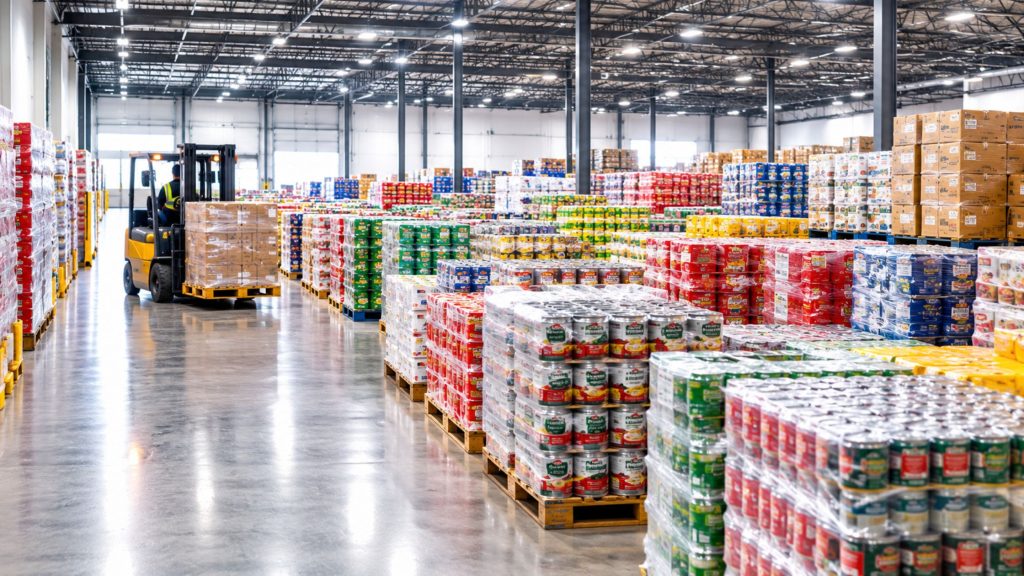
Well-run distribution warehouses use zoned storage (fast-moving stock near loading bays, slower-moving stock further back), regular stock audits, and tight integration between the warehouse management system and the delivery schedule. The result is stock that moves predictably, rather than sitting until it’s too late.
What Furniture Retailers Can Borrow from Food Inventory Discipline
Furniture doesn’t spoil, but it does depreciate in relevance, in condition, and in resale value the longer it sits unsold. The same principles that keep food businesses lean apply directly:
- Rotate showroom and warehouse stock so older collections don’t get buried behind new arrivals.
- Track condition, not just quantity scuffed or water-damaged stock needs the same early flagging as ageing food stock.
- Match freight choices to the item: full truckload freight for large seasonal restocks, less than truckload freight for smaller top-up orders.
- Use proper packaging services to prevent the kind of transit damage that turns saleable stock into a write-off.
Furniture businesses working with dedicated furniture warehousing and storage solutions often see the same wins food businesses do: fewer write-offs, tighter storage costs, and stock that actually turns over on schedule.
Expert Tips: 5 Quick Wins to Reduce Waste This Quarter
- Audit your current stock rotation if nobody can tell you the oldest item on the shelf without checking, that’s a rotation gap costing you money.
- Set reorder points based on actual sales velocity, not habit or gut feeling.
- Review your packaging spec at least once a year materials and product lines both change faster than most packing lists get updated.
- Compare full truckload freight and less than truckload freight costs quarterly, not just when a contract renews.
- Walk the warehouse floor monthly and physically check rotation software catches most issues, but not all of them.
Signs Your Inventory System Needs an Upgrade
| Warning Sign | What It Usually Means |
| Frequent ‘surprise’ expiry or write-offs | Rotation isn’t being tracked in real time |
| Rising storage costs with flat sales | Stock is sitting too long before moving |
| Emergency freight bookings | Ordering isn’t synced with actual demand |
| High damage/return rate | Packaging and handling need review |
| Manual stock counts taking days | Software and warehouse processes are out of sync |
| Not sure where your waste is coming from? Our team can review your current storage, packaging and freight setup and show you exactly where costs are leaking no obligation, just a straight answer. Get in touch for a free logistics review. |
Conclusion
Reducing waste and costs rarely comes down to one dramatic fix. It’s the combination of accurate inventory tracking, the right storage environment, sensible packaging, and freight choices that match how quickly your stock actually needs to move. Food businesses have had to master this out of necessity but the same discipline pays off just as clearly for furniture retailers managing seasonal stock, showroom turnover and warehouse space that isn’t getting any cheaper.
Whether you’re managing pallets of perishables or a warehouse full of sofas, the fundamentals are the same: know what you have, move it with intention, and don’t let good stock turn into a write-off simply because nobody was watching the clock.
Ready to tighten up your storage, packaging or freight strategy? Reach out to our logistics team for a tailored assessment of your current setup we’ll help you find the savings hiding in plain sight.
Frequently Asked Questions
Everything you need to know about our warehouse & 3PL services.
What is inventory management food and why does it matter?
Inventory management food refers to the systems and processes food businesses use to track stock levels, rotation and expiry across the supply chain. It matters because even small delays in spotting slow-moving stock lead directly to spoilage, markdowns and unnecessary reordering.
How do packaging services in Vancouver help reduce product waste?
Packaging services Vancouver providers use materials and designs matched to the product — insulated packaging for perishables, reinforced protection for fragile or heavy items like furniture — which cuts down on transit damage, returns and the waste that comes with both.
What’s the difference between full truckload freight and less than truckload freight?
Full truckload freight fills an entire trailer for one shipment, which is faster and involves less handling — ideal for large or perishable loads. Less than truckload freight shares trailer space with other shipments, which can lower cost for smaller loads but adds handling stops and slightly more transit time.
Why are food distribution warehouses important for reducing costs?
Food distribution warehouses centralise storage, sorting and dispatch, allowing stock to be organised by turnover speed and shipped out efficiently. This reduces the time products spend sitting idle, which is one of the biggest drivers of waste and storage cost.
Can furniture businesses use the same inventory principles as food companies?
Yes. While furniture doesn’t spoil, it does lose value the longer it sits unsold or gets damaged in storage. Rotation discipline, condition tracking and matching freight type to shipment size all translate directly from food inventory management to furniture retail.
How does storage logistics in Vancouver support better inventory control?
Storage logistics Vancouver providers offer climate-controlled, organised warehouse space with trained staff who follow proper rotation and handling procedures — giving businesses the physical infrastructure their inventory software needs to actually work as intended.